Research 2018 – OLD
National Undergraduate Research Week takes place this year from April 9-13, 2018. Each year in conjunction with this week, APSA showcases undergraduate research submitted by political science faculty and departments. The featured research can be the result of undergraduate coursework, capstone research, or departmental or college/university-wide undergraduate research efforts.
If your students are engaged in research projects this year, please let us know! Send a short description of any projects (with photos, if applicable) to teaching@apsanet.org.
Also, the Council on Undergraduate Research (CUR) will hold its National Conference on Undergraduate Research beginning on April 4, 2018 on the campus of the University of Central Oklahoma. CUR also hosts an annual “Posters on the Hill” event in Washington, D.C., which gives students the opportunity to showcase their research to Congressional members on Capitol Hill.
2018 Undergraduate Research Highlights
Elon University

Furman University

Pictured: Dr. Elizabeth Smith (center), with her two undergraduate researcher co-authors Nicole Hyman, Furman Class of ’18 (left) and Katherine West, Furman Class of ’19 (right).
Their research paper is entitled: “College Student Government and the Making Citizens: An Investigation into the Who Gets What, When and How on College Campuses.” With the ultimate goal of understanding the role of college student governments as socializing agents, especially their potential to motivate women and other underrepresented groups to participate in the real political world, they set out in this paper to describe how college student governments are operating on college campuses today. The co-authors present data regarding their goals, their power and professionalism, and their leadership. Data was collected via content analysis, survey and interview methodologies. They found that college student governments play important roles on college campuses and are reflecting the real political world in a number of ways including showing signs of increased diversity in representation.
Versions of the research were presented this year at the SPSA, MPSA and at Furman’s undergraduate research day, which is called Furman Engaged.
London School of Economics and Political Science

Furman University
Pictured: Dr. Elizabeth Smith (center), with her two undergraduate researcher co-authors Nicole Hyman, Furman Class of ’18 (left) and Katherine West, Furman Class of ’19 (right).
Their research paper is entitled: “College Student Government and the Making Citizens: An Investigation into the Who Gets What, When and How on College Campuses.” With the ultimate goal of understanding the role of college student governments as socializing agents, especially their potential to motivate women and other underrepresented groups to participate in the real political world, they set out in this paper to describe how college student governments are operating on college campuses today. The co-authors present data regarding their goals, their power and professionalism, and their leadership. Data was collected via content analysis, survey and interview methodologies. They found that college student governments play important roles on college campuses and are reflecting the real political world in a number of ways including showing signs of increased diversity in representation.
Versions of the research were presented this year at the SPSA, MPSA and at Furman’s undergraduate research day, which is called Furman Engaged.
The University of Texas at Tyler
 Nine undergraduate students at The University of Texas at Tyler completed a project to digitize 135 objects in the Timothy Anthony Jackson Collection of political memorabilia. This national collection of political campaign memorabilia from 1884 to 2012 is housed in the University Archives and Special Collections at The Robert R. Muntz Library. The project was a partnership between Aaron Ramirez, Archives Assistant, and Mark Owens, Assistant Professor, to promote primary resource literacy in a Political Science Research Methods class.
The students selected objects from various presidential campaigns to analyze, specifically Franklin D. Roosevelt to Bill Clinton. The class then invested significant time into researching details of each item as a first step to digitize a national collection of presidential campaign memorabilia. While digitizing the objects, students also provided a critical analysis of each primary resource and wrote descriptions that offer historical context for the object. The project is set to continue in 2019 and a report from each class will be published on UT Tyler’s institutional repository, Scholar Works at UT Tyler. For more details on the political memorabilia please visit: https://archivesspace.uttyler.edu.
Yale-NUS College (Singapore)
Peter Ooi Teik Aun‘s capstone project is entitled “Sisters in Islam: A Case of Islamic Civil Society”. Analyzing the case of the Malaysian Muslim women’s organisation Sisters in Islam through a Hegelian lens, Peter critiques the common view that Islam is antithetical to civil society. Tee Zhuo’s class paper, “The Special Assistance Plan: Singapore’s own bumiputera policy”, analyses educational inequality in Singapore. Tee argues that certain structural features of the school system perpetuate and entrench Chinese privilege in Singapore. Tee’s argument generated debate beyond the campus, resulting in an invitation to present at a scholarly conference later this year.
↕2017 Undergraduate Research Highlights
Cameron University
Wendy Whitman-Cobb, Assistant Professor of Political Science at Cameron University, shared information on CHiPS: The Cameron University Undergraduate Research Journal of History and Political Science . This is the second year of publication and this year’s volume features research by political science major Luis Jaquez entitled “Minimum Wage Politics: Half Baked or Full Potato?” His paper examines the effect of increases in the minimum wage on unemployment on low skilled individuals. CHiPS not only encourages students to pursue research but is also a reward for those that do. Since its introduction last year, CHiPS has not only encouraged our students but has excited them about the research process. CHiPS mimics as closely as possible the peer review process with papers reviewed not only by faculty but by senior students as well. We receive funding to print the journal as well as distribute it online.
Northeastern University
Nicholas Napolio’s honors thesis, titled “Administrative Action against Sexual Orientation Discrimination: A Study of the EEOC,” examines the Equal Employment Opportunity Commission’s 2015 decision interpreting the Civil Rights Act (1964) as extending antidiscrimination protections to employees on the basis of sexual orientation. He collected and analyzed original data on the work of the EEOC, and conducted elite interviews with EEOC staff. His findings suggest that the EEOC is a political actor, differentiated from the rest of the federal government, that avoids congressional and executive oversight to further its own institutional aims. His findings also suggest a significant relationship or dialogue between state civil rights commissions and the EEOC. Nicholas’ thesis was supervised by Professor Michael Tolley.University of Southern California
Under the supervision of Professor Benjamin A.T. Graham, Professor Jonathan N. Markowitz and Professor Megan Becker, the Security and Political Economy (SPEC) Lab at the University of Southern California encourages undergraduate scholars to support and conduct interdisciplinary, policy-relevant research on issues at the intersection of climate change, security, and economic development. With a focus on serving female, minority, and first generation students, the SPEC lab is building a close-knit community to foster the next generation of social science researchers. Regular training sessions in research design, data analytics and professionalization topics are conducted in the lab to provide undergraduate students with cutting-edge tools for academic research.
 This academic year, students have presented their work at the ISA West conference and served as co-authors on several posts on the Monkey Cage. They have supported faculty research on topics ranging from the security implications of global climate change to intervention in civil wars to the impact of diaspora investment in emerging markets. They have collected brand new data on military deployments in the Arctic and South China Sea, human rights enforcement mechanisms at the World Bank, and aided in the creation of the IPE Data Resource, which provides a compilation of all commonly used variables in IPE research in a single dataset. For more details on the lab’s projects and student involvement, please see our website: https://dornsife.usc.edu/spec.
University of Virginia
Dr. Lynn Sanders advisees are working on:
- Jury Nullification
Aryn Frazier is exploring the behavioral roots of jury nullification. Using a survey experiment, she will measure how the race of the defendant affects whether or not respondents refuse to convict a hypothetical individual accused of a crime. She then considers different arguments often made about the need to promote and defend the right of juries to remain independent. She hypothesizes that information about racial disparities in guilty verdicts will increase the respondent’s propensity to let the defendant free. - How Voters Will Evaluate Transgender Candidates
Abraham Axler is exploring how American voters evaluate trans-gender candidates. Using a survey experiment, he will measure how the gender identification of hypothetical candidates alters how respondents perceive their potential effectiveness in office, their likelihood of winning, and their moral qualifications to serve. He then considers arguments often made by transgender candidates for state and local office, and measures the effectiveness of those various frames. He hypothesizes that candidates who draw attention to their experiences as transgender individuals – from advocacy work to discrimination – are no more or less effective than those who claim their gender identity is irrelevant. - Relationships Between Civil Rights and Mental Health
Harrison grant winners Maria Winchell and Dillon Wild; they have results from survey experiments as well.
The Distinguished Majors Program, led by Dr. Peter Furia, has many students working on research projects. Working titles of these projects are as follows:
- Individual and Community-Level Predictors of Islamic Radicalization in the United States
Kara Anderson, advised by Sean Edwards - What Predicts Objective and Subjective Citizen Knowledge about the European Union?
Rachel Boisjolie, advised by Christine Mahoney - Press Freedom, Information Costs and the Success of Foreign Counterinsurgency Campaigns
Brandon Brooks, advised by John Owen - The Impact of Federal District Court Vacancies on the Quality of Judicial Decisions
Maddy Gates, advised by Lynn Sanders - Rural Food Deserts in Virginia: An Ethnographic Study
Clara Griff, advised by Paul Freedman - Gender Bias, Framing and Policy Preferences: An Experimental Study
April Gutmann, advised by Nick Winter - Regime Type and Peace Process-Spoiling by Pro-Government Militias
Pascal Hensel, advised by Phil Potter - The Genteel Corruption of Harry F. Byrd’s Party Organization
Aaron Jacobs, advised by Ken Stroupe - Individual, Institutional and Legal Factors Affecting the Success of US Asylum Claims by Central American Migrants
Madeleine Keach, advised by Milton Vickermann - Why have US presidential campaigns become uncivil?
Lucas Pulliza, advised by Sid Milkis - Predictors of Self-Censorship by Chinese Internet Users
Yule Wang, advised by Aynne Kokas - Attacks on the US Homeland: A Comparative Media Content Analysis of Pearl Harbor, 9/11 and the 2015-2016 ISIS-Inspired Attacks
Brett Warren, advised by Bruce Williams
↕2016 Undergraduate Research Highlights
Tufts University
Deborah Schildkraut , Professor and Chair of the Department of Political Science at Tufts, shared information on a “truly exceptional” thesis of Tufts senior, Sophie Laing. Laing’s thesis is: “Flip-Flopping Politicians: How Voters Punish and Reward a Changing of Opinion.” The motivation for the thesis is to examine whether a candidate’s gender matters and whether the reason given for the flip-flop matters in shaping how voters respond to candidate repositioning. Sophie designed and conducted her own experiment in which participants are shown a news article in which a fictional candidate is described as having changed his or her position on immigration reform and are then asked to evaluate the candidate on a range of characteristics. The analysis so far is preliminary, but at this point it seems that women are not punished for flip-flopping as much as one might think.
University of Montana
A team in the Department of Political Science at the University of Montana— Dr. Sara Rinfret , with a team of student researchers: Christina Barsky, Samuel Scott, and Hailey Duffin—created a survey instrument in collaboration with the Missoula County Elections Office staff and the Elections Advisory Committee. The intent of the survey was to examine a representative sample of registered voters in Missoula County, Montana to examine voter behaviors, voting preferences, and overall perceptions about the Missoula County Elections Office. In order to provide high quality results, the Missoula County Elections Office hired the WestGroup Research in Phoenix, AZ to collect the data via a telephone survey. The University of Montana research team was responsible for the data analysis of the telephone survey data collected through a written report for the Missoula County Elections Office.
Furman University
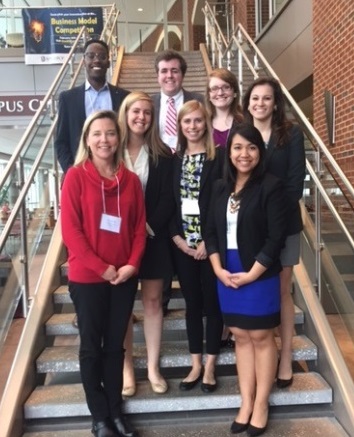 Seven Furman University political science undergraduates presented their Senior Research Papers at the annual meeting of the South Carolina Political Science Association. The presenters, pictured to the left, are Jonathan Kubakundimana, Joe Fretwell, Sarah Dunn, Elizabeth Bundy, Catherine Hinshaw, Mallary Taylor, and Oryza Astari. Their thesis advisor, Dr. Elizabeth S. Smith
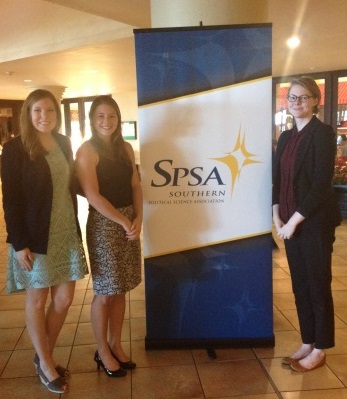 , is pictured on the lower left (in red).
In addition, three undergraduate students, Melissa Temple, Caroline Lancaster, and Julia Roberts, pictured at right, presented their research at the Southern Political Science Association meeting in San Juan, Puerto Rico. The work they presented was made possible by Furman Advantage research grants, which allows students to work with a professor on research over the summer.
Louisiana State University
Undergraduate Valencia Richardson, under the supervision of Dr. Kathleen Searles , wrote a senior thesis on youth-voter turnout on down-ballot and off-season elections. The research addresses the question: How does social media interaction between the 2015 gubernatorial candidates and college students affect student turnout? To this end, Ms. Richardson examined the social media presence of each gubernatorial candidate and did a post-election survey to determine both the level of awareness as well as the turnout rate of students at Louisiana State University. The results suggest that if candidates had more effectively reached out to students online, students would have been more aware of candidates and gotten more involved with the election.
Bryant University
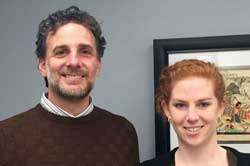 Undergraduate Quinn Massaroni , pictured at left with her professor, Richard Holtzman , was awarded the Bert & Phyllis Lamb Prize for Political Science, which recognizes one undergraduate student for excellence in writing and policy research. Ms. Massaroni won the award for her research paper, A United States Sustainable Energy Transition Based on Successful International Models . She originally produced this paper in a senior-level capstone seminar for Politics and Law majors taught by Professor Holtzman at Bryant University in Smithfield, RI. Ms. Massaroni will be recognized at the Western Social Science Association Conference in Reno, NV, April 13-16.
University of North Carolina, Chapel Hill
Undergraduate Logan Judy, under the supervision of Professor Timothy McKeown , wrote an Honors Thesis about whether the economic and political characteristics of a congressional district affect the Environmental Protection Agency’s stringency of enforcement in that district. Using EPA case records from their ECHO database and sGIS software to map individual cases into congressional districts, he then analyzed over 25,000 cases covering 2010 to 2015 for evidence that district income, unemployment, national unemployment, the voting pattern of the district, and the ideology of the member of Congress from that district affect how demanding EPA is in each enforcement case. His ordered probit regressions generally produced results that corroborated his hypotheses about these variables and their role in shaping enforcement.
University of California, Berkeley
The University of California, Berkeley Legal Studies’ annual Undergraduate Research Conference will take place on April 22, 2016. This conference, held each year, showcases original empirical and interdisciplinary research by 18 Honors Thesis students. The students’ names and thesis titles are all listed here , along with a short description of the conference. The Legal Studies program is incredibly proud of its Honors students, who have developed outstanding research projects over the course of an entire academic year. The Honors Program includes two semester-length research seminars that support students from the development of their thesis proposals to the execution of their research, under the guidance of dedicated faculty mentors.
Fordham University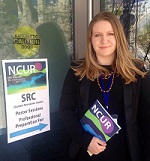
Undergraduate Maria DeCasper, pictured at right, made an oral presentation on her research, “Women’s Engagement in Antigovernment Protests in Ukraine,” at the National Conference on Undergraduate Research held at the University of North Caroline-Asheville in April 2016. She conducted in-depth interviews with female activists to investigate their motivations for participation in the 2013-2014 protest campaign against the incumbent government. Her mentor at Fordham is Professor Olena Nikolayenko .
Coastal Carolina University
Professor Holley Tankersley wrote in to recognize eight undergraduate research projects completed in the Politics Department and Edgar Dyer Institute for Leadership and Public Policy at Coastal Carolina University.
- Kelly Shelton, Department of Politics, “Public Land Use Reform and Environmental Justice”
Supervising Faculty: Richard Aidoo
This policy analysis suggests that state enforcement of environmental regulations in coastal South Carolina has not sufficiently addressed issues of environmental justice, and recommends a change in state regulations to channel revenue from corporate fines directly to those communities most affected by polluters. - Nicholas Blair, Edgar Dyer Institute for Leadership and Public Policy, “FEMA and Flood Plain Incentives”
Supervising Faculty: Pamela Martin
This paper investigates the flaws in flood insurance rates and subsidies with the goal of identifying solutions designed to make policies more economically and ecologically sustainable. - Kelsey Callahan, Edgar Dyer Institute for Leadership and Public Policy, “LGBTQ Workforce Preparation”
Superivising Faculty: Erin Donovan
This paper researches whether college and universities provide adequate resources for LGBTQ students to feel prepared to enter a hetero-normative workforce. This is an important and timely issue because of the recent advancements – and setbacks – in personal rights for those who identify with the LGBTQ community. - Shannon Condon, Edgar Dyer Institute for Leadership and Public Policy, “Campaign Finance Reform in Federal Elections”
Supervising Faculty: Drew Kurlowski
This research focuses on historical trends as explanatory factors in modern-day debates surrounding campaign finance reform. This APD approach suggests that alternative policy reforms must address path-dependent realities in order to be successful. - Sarah Harvey and Diana Evans, Department of Politics, “Defending Against C